
Soil Testing plays a central role in determining whether a construction site can safely support a structure. Every building, bridge, road, or foundation depends on the condition of the ground beneath it. Without proper Soil Testing, risks such as uneven settlement, cracking, or structural instability can emerge during or after construction.
Engineering teams rely on Soil Testing to understand how the ground behaves under load, how it reacts to moisture changes, and how its particles are arranged. These insights guide safe design decisions and reduce costly errors during construction. Soil Testing also supports compliance with building codes and engineering requirements, making it a core step in any serious development project.
Importance of Soil Testing in Construction Planning
Soil Testing provides essential data that helps engineers decide whether a site is suitable for development. The strength of the soil directly affects how much weight it can carry. Weak or unstable soil may lead to foundation failure if not properly identified before construction begins.
One major reason Soil Testing matters is its ability to reveal hidden soil conditions. Some sites may appear stable on the surface but contain soft layers, organic materials, or moisture-sensitive clay beneath. These conditions can compromise structural safety if left undetected.
Soil Testing also supports cost control. Early detection of poor soil conditions allows engineers to adjust foundation designs before construction starts. This prevents expensive repairs, redesigns, or structural corrections later in the project.
Key Engineering Properties Measured in Soil Testing
Soil Testing evaluates several important engineering properties that influence construction design.
Bearing capacity is one of the most critical factors. It defines how much load the soil can support without failure. Soil Testing measures this to determine foundation requirements.
Soil composition is also analyzed. Different particle sizes such as sand, silt, and clay affect drainage, stability, and load distribution. Soil Testing identifies the proportion of each component.
Plasticity is another key property. Clay-rich soils can change shape under pressure or moisture variations. Soil Testing helps determine how much a soil can deform before losing stability.
Moisture content is measured as well. Excess water in soil can reduce strength and increase settlement risks. Soil Testing identifies how water interacts with soil particles.
Common Soil Testing Methods Used in Engineering
Several established methods are used during Soil Testing to evaluate ground conditions accurately.
The Standard Penetration Test is widely used in field investigations. It measures soil resistance by driving a sampling tool into the ground. The results from this Soil Testing method help estimate soil strength at different depths.
Atterberg Limits testing is another important Soil Testing method. It determines the behavior of fine-grained soils when exposed to varying moisture levels. This helps engineers understand how clay soils will react during construction and long-term use.
Grain size analysis is used to classify soil particles. This Soil Testing method separates soil into gravel, sand, silt, and clay categories. The results help determine drainage behavior and compaction characteristics.
Field observation and sampling are also part of Soil Testing. These steps allow engineers to compare on-site conditions with laboratory results for more accurate interpretation.
ASTM Standards Used in Soil Testing
Soil Testing follows internationally recognized standards to ensure accuracy and consistency. ASTM guidelines provide structured procedures that engineers rely on for reliable results.
ASTM D1586 is used for penetration-based Soil Testing methods. It standardizes how soil resistance is measured during field work.
ASTM D4318 is applied for Atterberg Limits Soil Testing. It defines how soil plasticity is measured and classified.
ASTM D422 covers particle size distribution Soil Testing. It ensures uniform classification of soil samples across different projects.
Following these standards ensures that Soil Testing results remain consistent, repeatable, and suitable for engineering design and regulatory approval.
Field Testing and Laboratory Soil Testing
Soil Testing is divided into two main categories: field testing and laboratory testing.
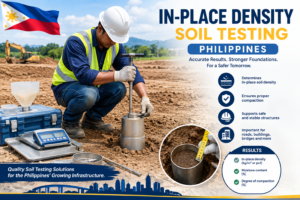
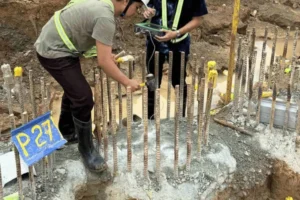
Field Soil Testing is conducted directly at the construction site. It provides real-time data about soil conditions at different depths. This type of Soil Testing helps engineers make immediate decisions during site investigation.
Laboratory Soil Testing focuses on detailed analysis of collected soil samples. It offers precise measurement of soil properties under controlled conditions. This form of Soil Testing is essential for confirming field results and refining engineering calculations.
When combined, both types of Soil Testing create a complete understanding of site conditions. Field results provide context while laboratory results offer precision.
Role of Accredited Laboratories in Soil Testing
Accredited laboratories play a major role in ensuring accurate Soil Testing results. These facilities follow strict testing procedures and quality control systems to maintain reliability.
Inch-On Materials Testing Laboratory is one example of a facility that performs Soil Testing following recognized engineering standards. The laboratory conducts both field and laboratory Soil Testing for soil, concrete, and foundation materials.
Accreditation from regulatory bodies ensures that Soil Testing results meet construction requirements. This level of oversight supports safe engineering decisions and improves confidence in project outcomes.
How Soil Testing Improves Structural Safety
Soil Testing directly influences structural safety by providing engineers with reliable ground data. A well-tested soil profile reduces uncertainty during design and construction.
One major benefit of Soil Testing is improved foundation design. Engineers can select appropriate foundation types such as shallow or deep foundations based on Soil Testing results.
Soil Testing also reduces structural risks. Identifying weak or unstable soil early prevents settlement issues that may lead to cracks or uneven surfaces.
Long-term durability improves as well. Structures built on properly evaluated soil tend to perform better over time with fewer maintenance issues.
When Soil Testing Should Be Conducted
Soil Testing should take place before any major construction activity begins. Early Soil Testing helps guide site planning and foundation design.
It is also necessary during site development stages. Soil Testing during this phase ensures that engineering plans match actual ground conditions.
Soil Testing may also be required when structural problems appear in existing buildings. Engineers use Soil Testing to identify soil-related causes of damage or instability.
Major renovation or expansion projects also require Soil Testing to confirm that the existing soil can support additional loads.
Choosing a Reliable Soil Testing Service Provider
Selecting a qualified Soil Testing provider is essential for accurate results. Several factors should be considered.
Accreditation is one of the most important requirements. A certified Soil Testing laboratory ensures compliance with engineering standards.
Experience also matters. Providers with a strong background in Soil Testing are more likely to deliver consistent and reliable results.
Equipment quality plays a role as well. High-precision Soil Testing instruments help reduce measurement errors and improve data accuracy.
Availability of both field and laboratory Soil Testing services is also important. A complete service provider can deliver a full assessment of site conditions.
Soil Testing as the Foundation of Safe Construction
Soil Testing remains one of the most important steps in any construction project. It provides essential data that supports safe design, stable foundations, and long-lasting structures.
Without proper Soil Testing, construction projects face higher risks of structural failure, unexpected settlement, and costly repairs. Reliable Soil Testing ensures that engineers understand the ground conditions before building begins.
Accredited laboratories such as Inch-On Materials Testing Laboratory continue to play a key role in delivering accurate Soil Testing services that support safe and efficient construction practices.
Frequently Asked Questions (FAQ)
What is Soil Testing?
Soil Testing is the process of analyzing soil properties to determine its strength, composition, and suitability for construction.
Why is Soil Testing important before construction?
Soil Testing helps engineers understand ground conditions and prevents structural issues such as settlement or foundation failure.
What does Soil Testing measure?
Soil Testing measures bearing capacity, moisture content, particle size distribution, and plasticity.
How long does Soil Testing take?
The duration of Soil Testing depends on site size and required analysis, but it typically ranges from a few days to several weeks.
Is Soil Testing required for all construction projects?
Most construction projects require Soil Testing to ensure safety and compliance with engineering standards.
What standards are used in Soil Testing?
Common standards include ASTM D1586, ASTM D4318, and ASTM D422, which guide proper Soil Testing procedures.