Grout plays an important role across many construction applications, particularly where filling, bonding, load transfer, stabilization, or structural support is required. While properly placed grout can contribute to a strong and durable construction system, defects that remain hidden below a surface may affect performance over time.
Grout integrity testing Philippines provides construction teams with technical information that can help evaluate grout condition and identify potential concerns. Depending on the application, testing may help assess grout strength, continuity, internal defects, voids, cracks, or other irregularities.
For contractors, developers, engineers, and project owners, professional testing can provide useful evidence for construction quality control. Inch-On Materials Testing Laboratory is a DPWH-BRS accredited Engineering and Construction Laboratory established in November 2018. The laboratory provides independent testing for soil and construction materials, along with field testing for soil, concrete, and foundation piles using specialized equipment.
What Is Grout Integrity Testing?
Grout integrity testing Philippines refers to the evaluation of grout condition using an appropriate testing or inspection method selected according to the material, application, structural element, project specifications, and engineering requirements.
Grout may be used within masonry systems, structural connections, foundation-related applications, equipment supports, repair work, and other construction assemblies. A grout system may look satisfactory from its exposed surface while still containing internal areas that require further evaluation.
Testing can provide information that visual inspection cannot always establish. Depending on the selected procedure, evaluation may focus on characteristics such as:
- Internal voids
- Cracks or discontinuities
- Poor consolidation
- Incomplete filling
- Weak areas
- Grout continuity
- Material strength
- Uniformity
- Possible inclusions or irregularities
For masonry grout, ASTM C1019 provides procedures for field and laboratory sampling and compression testing of grout used for masonry construction. ASTM states that the method can support grout proportion selection and quality control for uniformity of grout preparation.
The appropriate approach should always be determined by the project’s technical requirements rather than applying one testing procedure to every grout application.
Why Grout Integrity Matters for Construction Projects
Grout can perform a critical function within a construction assembly. A defect, void, weak area, or discontinuity may affect the expected behavior of the grouted element.
Professional Grout integrity testing Philippines services can therefore support quality-control programs by providing measurable technical information for review by engineers and construction teams.
Structural Performance
Grout may transfer loads, fill spaces, support connections, or provide continuity within a construction system. Its condition can therefore matter when engineers assess structural performance.
Testing can provide additional information about the condition of the grout and help project teams determine whether further investigation may be appropriate.
Durability and Service Life
Voids, cracks, poor consolidation, and other defects may create areas that require attention during construction quality assessment. Depending on exposure conditions and application, these conditions may also affect long-term performance.
A suitable Grout integrity testing Philippines program can help identify areas requiring further engineering review or corrective action.
Construction Quality Control
Quality control depends on reliable information. Visual inspection, installation records, material documentation, and laboratory results can work together to provide a clearer picture of construction quality.
Testing results can give project teams objective data that may be compared against applicable project requirements.
Project Specification Compliance
Construction projects often contain specific requirements for materials, workmanship, sampling, testing frequency, acceptance criteria, and documentation.
Grout integrity testing Philippines should therefore be planned around the project’s drawings, specifications, applicable standards, and instructions from the responsible engineer.
Common Applications for Grout Integrity Testing Philippines
The need for grout evaluation can vary according to the construction system. Potential applications include masonry, structural construction, foundation work, infrastructure, and industrial facilities.
Foundation and Pile-Related Applications
Foundation systems require careful quality verification because defects may be difficult to observe after construction.
While pile integrity testing and grout evaluation are separate testing applications, both can form part of a broader foundation quality-control program.
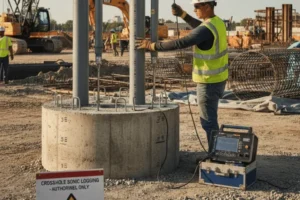
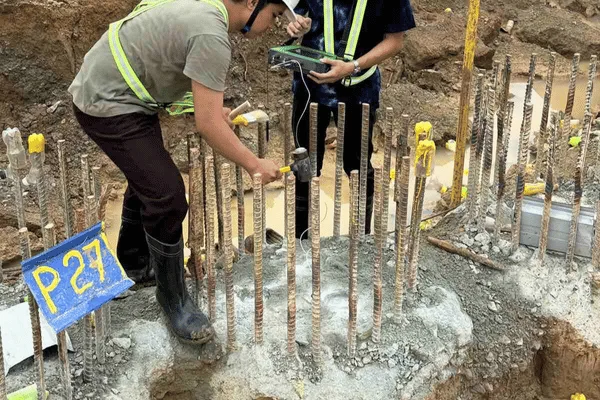
Inch-On Materials Testing Laboratory provides pile integrity and dynamic testing services, including Low-Strain Pile Integrity Testing and High-Strain Dynamic Testing. Its pile integrity testing service identifies conditions such as cracks, fractures, necking, and soil inclusions within piles.
For projects involving grouted foundation components, engineers can determine whether additional grout evaluation is appropriate.
Structural Grouting
Grout may be used around structural connections, equipment supports, base plates, and other structural components.
Testing can support construction documentation by providing information about the material or installed condition, depending on the selected test procedure.
Masonry Construction
Masonry grout is placed within or between masonry units to form part of the wall system. ASTM C1019 specifically addresses sampling and compression testing of masonry grout. The standard notes that specimen preparation considers the absorption characteristics of the masonry units used during construction.
For masonry projects, Grout integrity testing Philippines may form part of a broader quality-control program covering grout, concrete hollow blocks, reinforcement, aggregates, and other construction materials.
Infrastructure Projects
Large infrastructure projects often involve multiple material-testing requirements. Bridges, commercial facilities, industrial structures, highways, and other developments may require field and laboratory testing throughout different construction stages.
A coordinated testing program can help project teams maintain proper documentation and technical oversight.
Methods Used for Grout Integrity Evaluation
There is no single testing method suitable for every grout application. The correct procedure depends on the type of grout, location, geometry, construction stage, required information, and applicable project specifications.
Non-Destructive Testing Methods
Non-destructive evaluation can provide information about internal conditions while minimizing physical damage to the tested element.
Ultrasonic techniques are among the approaches used for evaluating certain construction materials. Inch-On Materials Testing Laboratory provides Ultrasonic Testing services, including Ultrasonic Pulse Velocity testing for concrete quality and integrity. Its published service information states that UPV can assist with assessing concrete uniformity and identifying internal voids and cracks.
For a specific grout application, engineers and testing specialists should determine whether an ultrasonic technique is technically suitable.
Destructive or Laboratory-Based Evaluation
Some grout evaluations involve specimen sampling followed by laboratory testing.
ASTM C1019 covers field and laboratory sampling and compression testing of grout used for masonry construction. The method can support quality control and grout proportion evaluation.
Laboratory testing may provide controlled conditions for evaluating selected material characteristics. Sample identification, preparation, curing, testing, and reporting should follow the applicable procedure.
Visual and Site-Based Assessment
Visual inspection remains useful as part of a broader quality-control process.
Project personnel may document:
- Surface cracks
- Visible voids
- Poor filling
- Discoloration
- Installation conditions
- Accessible areas
- Grout placement records
- Construction-stage observations
However, visible inspection cannot always confirm internal grout condition. That is why Grout integrity testing Philippines can be valuable when project requirements call for additional technical verification.
How Grout Integrity Testing Is Conducted
A professional testing program generally begins with understanding the construction application and the information required by the project team.
1. Project and Test Requirement Review
The testing laboratory and project team can review:
- Construction drawings
- Project specifications
- Grout type
- Structural application
- Testing requirements
- Applicable standards
- Previous inspection records
- Existing test results
This step helps establish an appropriate testing approach.
2. Site Inspection and Test Planning
The next stage may involve reviewing the test location, accessibility, geometry, construction condition, and available documentation.
For Grout integrity testing Philippines, careful planning is important because testing conditions can vary significantly between masonry walls, structural connections, foundations, and other applications.
3. Field Testing or Sample Collection
Depending on the selected method, technicians may conduct testing directly at the project site or collect specimens for laboratory evaluation.
Proper identification and documentation help maintain sample traceability and support reliable reporting.
4. Laboratory Analysis When Required
Laboratory evaluation may involve specimen preparation, curing, measurement, and testing based on the selected standard.
Inch-On Materials Testing Laboratory provides laboratory testing for soil and construction materials using specialized apparatus. Its published services also include Concrete Hollow Block testing, reinforcing steel and product testing, aggregate testing, asphalt testing, and soil testing.
5. Data Review and Technical Reporting
The final stage involves organizing test observations and results into technical documentation.
A useful report may include:
- Project identification
- Test location
- Test date
- Test method
- Equipment information
- Sample identification
- Measured results
- Relevant observations
- Applicable acceptance criteria
- Technical remarks
Clear reporting allows engineers, contractors, and project managers to review the findings and determine appropriate next steps.
Standards and Quality Requirements for Grout Testing
Standards help establish consistent testing procedures and technical expectations.
ASTM C1019-26 is the current ASTM standard titled Standard Test Method for Sampling and Testing Grout for Masonry. It covers field and laboratory sampling and compression testing of masonry grout.
The applicable standard for a particular Grout integrity testing Philippines project depends on the test method and application. ASTM and AASHTO standards may apply to different material-testing procedures, while project specifications and Philippine requirements may establish additional criteria.
Inch-On Materials Testing Laboratory states that its testing services follow ASTM and AASHTO testing standards. The laboratory is also accredited by the Department of Public Works and Highways – Bureau of Research and Standards.
Testing equipment, calibration, technician competency, sample handling, and reporting procedures also contribute to dependable test results.
Why Choose a DPWH-BRS Accredited Materials Testing Laboratory?
Choosing a qualified laboratory can help construction teams establish a consistent process for material verification and technical documentation.
Inch-On Materials Testing Laboratory is a DPWH-BRS accredited Engineering and Construction Laboratory established in November 2018. It operates as an independent testing laboratory focused on soil and construction materials. The laboratory also conducts in-situ testing of soil, concrete, and foundation piles.
Laboratory Testing Capabilities
Construction quality programs may require several types of material testing rather than one isolated test.
Inch-On’s laboratory services include:
- Coarse aggregate testing
- Fine aggregate testing
- Asphalt testing
- Soil testing
- Reinforced steel bar and product testing
- Concrete Hollow Block testing
These services can support broader construction quality-control programs alongside appropriate grout evaluation.
Field Testing Capabilities
Field testing allows technical information to be gathered directly from actual project conditions.
Inch-On lists several field-testing services, including:
- Field Density Testing
- Rebound Hammer Testing
- Rebar Scanning
- Pile Integrity Testing
- Pile Dynamic Testing
- Crosshole Sonic Logging
- Standard Penetration Testing
- Geotechnical Soil Investigation
- Ultrasonic Testing
These services demonstrate the laboratory’s broader capability for field-based construction and foundation evaluation.
Benefits of Professional Grout Integrity Testing
Professional Grout integrity testing Philippines can offer several practical benefits when incorporated appropriately into a construction quality-control program.
Early Identification of Potential Defects
Testing may identify conditions that require further review before they become more difficult to address.
Better Construction Quality Control
Objective test data can complement inspection records, material certificates, construction observations, and other quality-control documentation.
Improved Engineering Decision-Making
Engineers can use appropriate test results as one source of technical information when evaluating construction conditions.
Documented Project Verification
A formal testing report can provide a useful record of the procedure, location, results, and relevant observations.
Reduced Construction Uncertainty
Testing does not replace engineering judgment, but it can provide measurable information that supports technical assessment.
When Should You Request Grout Integrity Testing?
The appropriate timing depends on the construction sequence and project requirements.
Potential situations include:
- During grout quality-control programs
- After grout installation
- Before critical construction stages
- When visible defects are observed
- When installation concerns arise
- During structural assessment
- During repair or rehabilitation projects
- When project specifications require testing
- When an engineer requests additional verification
For existing structures, the available testing options will depend on accessibility, construction type, grout condition, element geometry, and the information required.
Project teams should establish testing requirements before construction whenever possible. Early planning can help coordinate site access, sampling, laboratory schedules, documentation, and engineering review.
Grout Integrity Testing vs. General Concrete Testing
Grout testing and concrete testing can involve related material characteristics, but they are not automatically interchangeable.
| Testing Focus | Main Purpose |
|---|---|
| Grout Integrity Testing | Evaluates grout condition, continuity, or selected material properties using an appropriate procedure |
| Concrete Strength Testing | Evaluates specified strength characteristics of concrete |
| Aggregate Testing | Evaluates properties of coarse and fine aggregates |
| Soil Testing | Determines selected engineering properties of soil |
| Foundation Testing | Evaluates selected characteristics or performance of foundation elements |
A project may require several testing categories. The correct combination depends on the structural design, construction materials, specifications, and engineering requirements.
How to Select a Grout Testing Laboratory in the Philippines
Selecting a laboratory for Grout integrity testing Philippines requires more than checking whether a company offers a particular test.
Consider the following factors:
Accreditation
Check whether the laboratory has relevant accreditation for its stated services.
Appropriate Equipment
The laboratory should have suitable equipment for the required testing method.
Technical Personnel
Qualified personnel are essential for proper field testing, laboratory procedures, data collection, and reporting.
Testing Standards
Ask which ASTM, AASHTO, project, or other applicable standards govern the proposed procedure.
Field Capability
For projects requiring on-site assessment, field-testing capability can simplify coordination and data collection.
Laboratory Capability
Laboratory resources can be important when specimens require controlled preparation, curing, measurement, or testing.
Clear Technical Reports
Reports should provide sufficient information for engineers and project teams to understand what was tested, where it was tested, which method was used, and what results were obtained.
Why Inch-On Materials Testing Laboratory Can Support Construction Quality Verification
Inch-On Materials Testing Laboratory provides independent field and laboratory testing services for construction and engineering applications.
Established in November 2018, the laboratory is DPWH-BRS accredited and follows ASTM and AASHTO testing standards. Its published service portfolio covers soil, concrete, construction materials, foundation piles, aggregates, asphalt, reinforced steel products, and Concrete Hollow Blocks.
The laboratory also provides specialized field testing, including Ultrasonic Testing, Rebound Hammer Testing, Pile Integrity Testing, Dynamic Pile Testing, and Crosshole Sonic Logging.
For projects seeking Grout integrity testing Philippines, the first step is to discuss the grout application, structural element, project specification, existing documentation, and desired test information with the laboratory. This allows the appropriate testing approach to be considered rather than assuming that one method applies to every project.
Frequently Asked Questions About Grout Integrity Testing Philippines
What is grout integrity testing?
Grout integrity testing Philippines involves evaluating grout condition or selected grout properties using an appropriate field or laboratory testing method. Depending on the application, testing may provide information about strength, continuity, voids, cracks, weak areas, or other conditions.
Why is grout integrity testing important?
Grout may serve structural, filling, bonding, support, or stabilization functions. Testing can provide technical information that supports construction quality control and engineering assessment.
What defects can grout integrity testing detect?
The detectable conditions depend on the selected method. Possible findings may include voids, discontinuities, cracks, incomplete filling, weak zones, inclusions, or other irregularities.
Is grout integrity testing destructive?
Not always. Some evaluation methods are non-destructive, while other procedures require specimens or physical samples. The appropriate approach depends on the project requirements and the information needed.
What standard applies to grout testing?
ASTM C1019 covers sampling and compression testing of grout used for masonry construction. Other testing procedures may have different standards. The applicable standard should be selected according to the grout application and project requirements.
Can grout testing be performed on an existing structure?
Potentially, yes. Testing options for an existing structure depend on the construction type, accessibility, grout location, geometry, condition, and required information. A technical assessment should determine the appropriate procedure.
Does Inch-On Materials Testing Laboratory provide construction material testing?
Yes. Inch-On provides laboratory testing for construction materials, including aggregates, asphalt, soil, reinforced steel products, and Concrete Hollow Blocks. Its field-testing services cover areas such as concrete, soil, foundation piles, and ultrasonic evaluation.
How can I request Grout integrity testing Philippines services?
Start by providing the laboratory with project details, grout type, construction application, drawings or specifications where available, test location, and the type of information required. The laboratory can then assess the appropriate testing requirements.
Takeaway: Verify Grout Quality With Reliable Testing
Quality grout can contribute to the performance and durability of many construction systems, but visual inspection alone may not provide enough information about internal conditions or material properties.
Grout integrity testing Philippines can provide useful technical data for construction quality control, engineering assessment, project documentation, and defect investigation. The correct test method depends on the grout application, structural element, project specifications, applicable standards, and information required by the responsible engineer.
Inch-On Materials Testing Laboratory provides independent field and laboratory testing services and is a DPWH-BRS accredited Engineering and Construction Laboratory. Its capabilities cover construction materials, soil, concrete, foundation piles, and several specialized field-testing applications.
For a construction project requiring Grout integrity testing Philippines, professional consultation can help establish the appropriate testing method, sampling requirements, site procedures, applicable standards, and technical reporting needs.
Need reliable materials testing for your construction project? Contact Inch-On Materials Testing Laboratory to discuss your project requirements and determine an appropriate testing approach.