Why In-Place Density Soil Testing Is Essential for Philippine Construction Projects
Every successful construction project begins with proper ground preparation, and soil compaction is one of the most important factors in achieving a stable construction site. In-place density soil Philippines testing helps contractors, civil engineers, and developers determine whether soil has been compacted sufficiently to meet the requirements of a project. This testing process measures the density of soil directly in the field and provides information that can be compared with laboratory compaction results. When soil is not compacted adequately, structures, roads, and other improvements may experience settlement, uneven surfaces, or premature deterioration. Reliable field density measurements allow construction teams to identify potential problems before additional work covers the affected soil layer. These tests are particularly valuable for projects that require documented quality control and compliance with approved engineering specifications. By incorporating soil density testing into the construction process, project teams can improve their ability to deliver stable and durable earthworks.
The need for dependable soil testing is especially relevant in the Philippines, where construction sites may contain different soil types and experience changing weather conditions. Some locations have sandy materials, while others contain clay-rich soils, silty deposits, gravel, or mixed earthwork materials. Heavy rainfall can also change soil moisture conditions and complicate compaction activities. These differences mean that contractors cannot rely on a single compaction procedure for every site. Instead, they need appropriate testing methods and acceptance criteria based on the material and the intended use of the ground. Professional field density testing provides measurable information that helps engineers assess whether the prepared soil meets the requirements established for the project. With accurate results and proper interpretation, construction teams can make better decisions about earthwork preparation and subsequent building activities.
What Is In-Place Soil Density Testing?
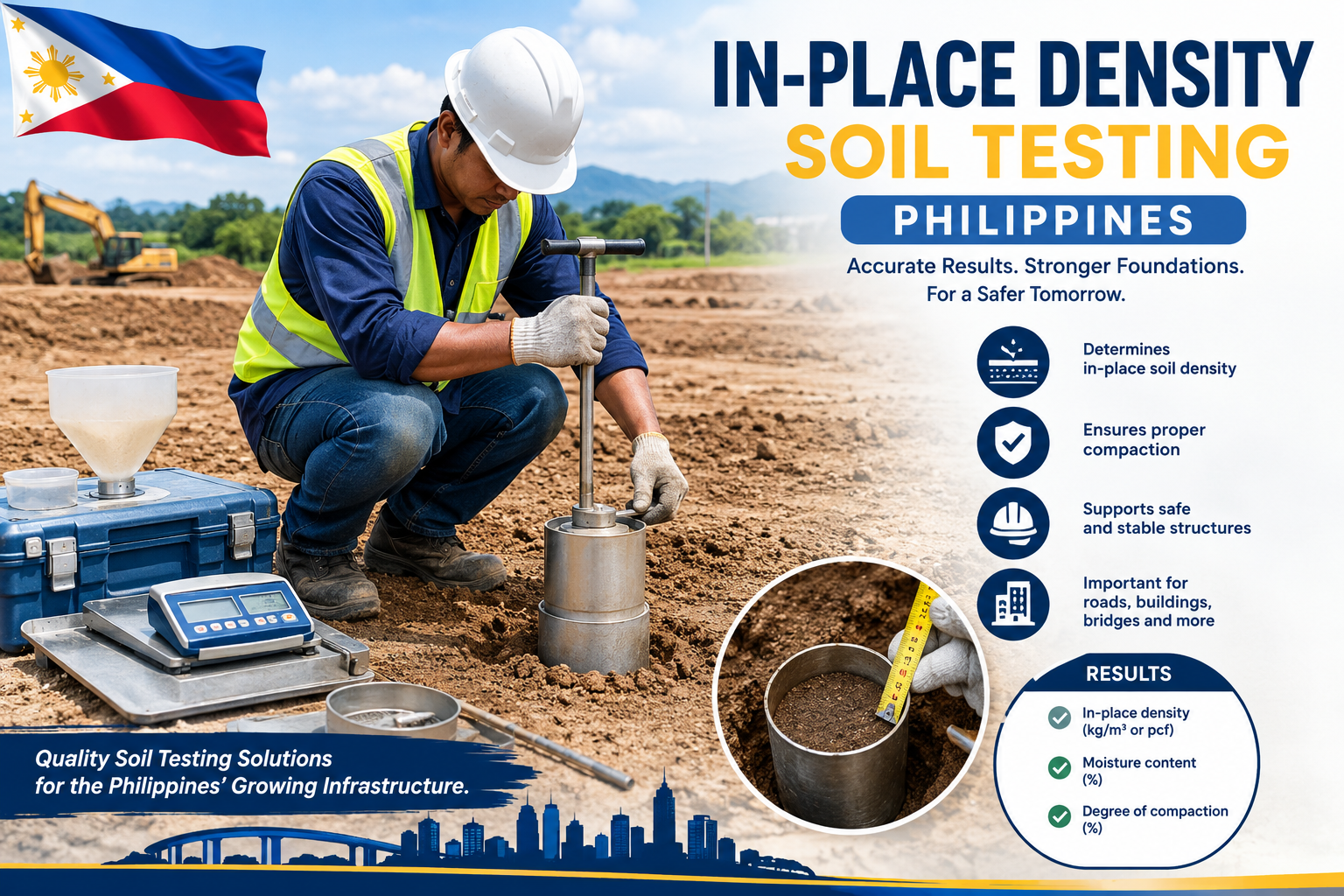
In-place soil density testing is a field procedure used to determine the density of soil in its existing or compacted condition. During construction, soil is often placed in layers and compacted using specialized machinery to improve its engineering performance. Field density testing checks the resulting condition of the compacted material rather than relying only on visual inspection or the number of passes made by a compactor. Depending on the selected method, a technician may measure the mass of excavated soil and determine the volume of the test hole or use approved instrument readings. The measured information is then used to calculate the soil’s density and, when required, its dry density. The result can be compared with the maximum dry density established through a suitable laboratory compaction test. This comparison helps determine whether the soil has achieved the relative compaction required by the project specifications.
Field density testing is not limited to one particular type of construction project. It can be used for compacted fill beneath buildings, prepared road subgrade, embankments, backfilled trenches, and other earthwork applications. The test method must be appropriate for the soil material and consistent with the standards specified in the project documents. Engineers also need reliable laboratory reference values to interpret field results correctly. A density measurement by itself does not establish whether soil is suitable for every engineering purpose. Soil strength, settlement potential, drainage, groundwater conditions, and other factors may require separate evaluation. Understanding these distinctions helps contractors use field density results as part of a comprehensive construction quality-control program.
Major Construction Applications of In-Place Density Soil Philippines Services
In-place density soil Philippines services support a wide range of construction activities, from small residential developments to major infrastructure projects. For building construction, field testing helps verify the compaction of prepared ground and engineered fill before foundation work progresses. Commercial developments may require testing beneath parking areas, access roads, loading zones, and building platforms. Road construction teams use density measurements to evaluate compacted subgrade and other earthwork layers according to the applicable specifications. Industrial facilities may also need testing beneath equipment foundations, warehouses, storage yards, and areas used by heavy vehicles. In drainage and utility projects, field testing can help assess compacted backfill placed around trenches and underground installations. These applications demonstrate how soil density testing contributes to construction quality control across different project types.
Proper testing is important whenever the performance of compacted soil affects the work that follows. For example, a poorly compacted road subgrade may contribute to uneven pavement performance under repeated traffic loading. Inadequately compacted fill beneath a building platform may create conditions that increase the risk of localized settlement. Backfill around utility installations may also require suitable compaction to reduce unwanted movement or surface depressions. However, the required density and testing frequency vary according to the material, location, and engineering requirements. Project teams should consult the approved plans, technical specifications, and responsible engineer when establishing a testing schedule. Conducting the required tests before covering the relevant layer makes it easier to identify and correct deficiencies. This proactive approach supports more consistent construction quality and reduces avoidable rework.
Common Methods for Measuring Soil Density in the Field
Several methods are available for measuring in-place soil density, and each has its own operating principles and limitations. The selection process should consider the soil’s particle size, stability, moisture conditions, and suitability for the proposed procedure. Project specifications may also require a particular method to maintain consistency with established testing and acceptance criteria. Qualified testing personnel should confirm the method before fieldwork begins. Proper calibration, accurate measurements, and compliance with the relevant procedure are essential for producing dependable results. Construction teams should also ensure that the laboratory reference used to calculate relative compaction is appropriate for the material under evaluation. The following methods are commonly considered for field density testing.
Sand-Cone Density Test
The sand-cone method is a recognized procedure for determining the in-place density of suitable compacted soil. The technician excavates a small hole at the selected location and collects the removed soil for weighing and moisture-content determination. A calibrated sand-cone apparatus is then used to determine the volume of the hole by measuring the amount of calibrated sand required to fill it. The mass of the excavated soil divided by the measured hole volume provides the field wet density. Dry density can then be calculated using the soil’s moisture content. ASTM D1556/D1556M provides a recognized standard for the sand-cone method, although the applicable edition must be confirmed against the project documents. The method is useful for many suitable earthwork materials, but it may be inappropriate when coarse particles, unstable holes, or other conditions interfere with accurate measurements.
Nuclear Density Gauge Testing
A nuclear density gauge uses specialized equipment to measure soil density and may also measure moisture content through an associated procedure. One advantage is the ability to obtain field readings relatively quickly when compared with some traditional testing methods. This can be beneficial for projects that require numerous measurements during earthwork operations. Nevertheless, the equipment requires trained and authorized operators who understand the instrument’s limitations and applicable radiation-safety procedures. Calibration, instrument condition, soil composition, and measurement technique can influence the reliability of the results. Not every soil type or construction situation is suitable for this method, so the project specifications must permit its use. Contractors should confirm the testing provider’s qualifications and regulatory compliance before arranging nuclear gauge testing.
Other Field Density Testing Methods
The rubber balloon method determines the volume of an excavated test hole using a calibrated flexible membrane device. The measured volume and the mass of the removed soil are used to calculate field density. The drive-cylinder method involves collecting a soil sample in a cylinder of known volume and determining its mass. This method is suitable only when the soil can be sampled without significant disturbance or compression that would affect the measurement. Certain fine-grained soils may be appropriate, while materials containing substantial coarse particles may not be suitable. Both methods require careful attention to equipment condition, sample handling, and the prescribed procedure. A geotechnical professional should determine which method is appropriate for the material and project requirements.
How the In-Place Density Soil Testing Process Works
A structured testing process helps ensure that field measurements are accurate, traceable, and useful for construction decisions. The first step is reviewing the project specifications to identify the required density, reference laboratory test, testing method, and acceptance criteria. The technician then identifies the designated test location and confirms which compacted layer needs to be evaluated. The test area is prepared according to the selected method without unnecessarily disturbing the soil being tested. Depending on the equipment, the technician may excavate a test hole, weigh the removed material, measure the hole volume, or obtain instrument readings. Moisture content is determined when required so that field dry density can be calculated correctly. The resulting value is compared with the appropriate laboratory maximum dry density, and the findings are documented in a field test report.
When the measured result does not satisfy the specified requirement, the contractor should coordinate with the responsible engineer to determine the appropriate corrective action. The affected soil may require additional compaction, moisture adjustment, or other approved treatment. In some circumstances, the material or testing procedure may need further investigation before a decision is made. Retesting should follow the project’s quality-control procedures after the necessary corrective work is completed. Records should identify the original result, the action taken, and the subsequent test findings. This documentation helps demonstrate how the affected area was evaluated and addressed. Following a consistent process also helps prevent unsuitable or unaccepted material from being covered before the required checks are completed.
Interpreting Field Density Results and Compaction Requirements
Correct interpretation of soil density results is essential because a field measurement must be evaluated against the appropriate reference value. Wet density includes the mass of the soil solids and the moisture present in the sample, while dry density accounts for the mass of the soil solids without the water. Laboratory compaction tests establish a moisture-density relationship for a specified compaction procedure. Maximum dry density is the highest dry density achieved under that procedure, while optimum moisture content is the corresponding moisture level. ASTM D698 and ASTM D1557 are recognized standards for laboratory compaction testing using different compaction efforts. The correct procedure depends on the project’s technical requirements and the soil being evaluated. Field dry density is then compared with the applicable laboratory maximum dry density to determine relative compaction.
The relative compaction calculation is:
Relative Compaction (%) = (Field Dry Density ÷ Maximum Dry Density) × 100
For example, if the measured field dry density is 1.82 g/cm³ and the laboratory maximum dry density is 1.92 g/cm³, the relative compaction is approximately 94.8%. This figure represents the field dry density as a percentage of the laboratory maximum dry density. Whether the result is acceptable depends on the specified requirement for the particular construction layer. A project requiring at least 95% relative compaction would not automatically accept a result of 94.8%, subject to the project’s prescribed evaluation and reporting procedures. Another project may have a different requirement based on the material and intended application. Engineers should therefore interpret results using the approved specifications rather than assuming that one percentage applies to all construction work.
Philippine Testing Standards and Quality Assurance Practices
Construction projects in the Philippines may refer to DPWH specifications, ASTM standards, AASHTO procedures, and other applicable technical requirements. The exact requirements depend on the type of project, contract documents, material, and responsible authority. Field density testing may be specified through recognized procedures such as AASHTO T 191 or ASTM D1556/D1556M for the sand-cone method. Laboratory compaction testing may use ASTM D698, ASTM D1557, or corresponding methods identified in the project specifications. The selected laboratory procedure must be consistent with the reference value used to evaluate the field results. Contractors should verify the current applicable edition and any project-specific modifications before testing begins. These steps help ensure that field density results are interpreted consistently and appropriately.
Quality assurance also depends on accurate records and clear communication among project participants. A field density report should identify the test location, date, method, relevant material information, measured values, calculations, and assessment against the specified criteria. Where necessary, the report should reference the corresponding laboratory compaction data. Test frequency and location should follow the approved testing plan rather than an informal schedule. Engineers may require additional measurements when materials change, a result fails, or site conditions raise concerns. Qualified personnel and suitable equipment are essential for reliable measurements. Maintaining complete records helps contractors demonstrate that the required testing and corrective actions were carried out.
Factors That Can Influence Soil Compaction Results
Soil density test results can be affected by material properties, site conditions, and construction practices. Soil type is particularly important because sandy soils, clay-rich soils, silts, and gravelly materials respond differently to moisture and mechanical compaction. Moisture content can affect how easily particles rearrange during compaction, and the optimum level varies according to the soil and laboratory procedure. Compaction equipment must also be suitable for the material and the available working space. If soil is placed in excessively thick layers, compaction may be inconsistent through the full depth of the lift. Heavy rainfall can increase moisture content, soften certain materials, and disrupt the construction schedule. Testing personnel must also follow the selected method carefully because improper measurements or unsuitable test locations can affect the reliability of the results.
Contractors can improve consistency by checking soil conditions before compaction and adjusting their procedures according to the approved requirements. Appropriate lift thicknesses and equipment settings can help achieve more uniform compaction. Moisture conditioning should be managed carefully rather than relying on visual appearance alone. Field density testing should be carried out at the required stages so deficiencies can be addressed before the next layer is placed. When results vary unexpectedly, engineers should investigate possible differences in material, moisture, compaction effort, or testing conditions. A failed result should not be dismissed without an appropriate technical assessment. By identifying the cause of a problem, construction teams can select corrective measures that are more likely to produce the required outcome.
Selecting a Reliable In-Place Density Soil Testing Provider in the Philippines
Choosing a suitable testing provider is an important decision for contractors and developers who require reliable field measurements. Start by checking whether the provider has experience with the relevant soil materials and construction applications. Ask whether it offers the required field density method and whether that method complies with the project’s specifications. Confirm applicable laboratory accreditation, qualifications, equipment capabilities, and quality-control procedures. A dependable provider should be able to explain its testing scope, site requirements, reporting format, and expected schedule. It should also clarify whether laboratory compaction testing is available when a maximum dry density reference needs to be established. Reviewing these details helps project teams assess the provider’s suitability before committing to the service.
Before requesting a quotation, prepare information about the project location, the type of earthwork, the number of expected test locations, and the required testing schedule. Providing the relevant technical specifications helps the laboratory identify the correct method and testing requirements. Contractors should ask how field measurements will be documented and how quickly reports can be delivered under the agreed service arrangement. They should also confirm travel arrangements, site access, and any requirements for preparing the testing area. Comparing technical qualifications and service scope is generally more useful than selecting a provider solely because of a low quoted price. Proper planning can help avoid scheduling conflicts and unnecessary repeat visits. Coordination between the laboratory, site engineer, and contractor supports smoother quality-control operations.
Benefits of Professional Soil Density Testing for Construction Projects
Professional field density testing gives project teams measurable evidence of the compaction achieved in the field. This information helps engineers determine whether a soil layer meets the applicable acceptance requirements before the next construction stage begins. Timely testing can reveal localized deficiencies that might otherwise remain hidden beneath additional fill, pavement, or structural work. Identifying problems early can make corrective action more practical and may reduce avoidable rework. Properly documented results also support inspection activities, project records, and communication among contractors and consultants. Using a method suited to the soil and project requirements improves the relevance of the information obtained. These benefits make field density testing a valuable part of earthwork quality control.
However, density testing should be treated as one component of a broader engineering evaluation rather than a guarantee of overall soil suitability. A layer may meet its compaction requirement while still requiring separate assessment for bearing capacity, settlement, drainage, or other design considerations. Geotechnical investigations and engineering analysis remain necessary when required by the project. Contractors should follow the approved plans and seek professional guidance when test results raise concerns. Consistent quality-control procedures help ensure that compaction deficiencies are addressed before they affect subsequent work. Reliable testing, proper documentation, and informed decision-making contribute to better management of construction risks. For projects across the Philippines, these practices support a more systematic approach to preparing stable ground.
Frequently Asked Questions (FAQ)
What does in-place density soil testing measure?
In-place density soil testing measures the density of soil directly at a construction site. The results help engineers assess the condition of compacted soil and compare its dry density with the appropriate laboratory reference. This comparison is used to evaluate whether the specified compaction requirement has been achieved.
Why do construction projects in the Philippines need field density testing?
Field density testing helps verify the quality of compacted soil used beneath foundations, roads, embankments, and other construction works. Because soil types and moisture conditions vary across the Philippines, testing helps project teams evaluate actual field conditions rather than relying solely on visual inspection. The required tests should follow the project’s approved specifications.
What is the difference between the sand-cone method and the nuclear density gauge method?
The sand-cone method determines the volume of an excavated test hole using calibrated sand and combines that measurement with the mass of the removed soil. A nuclear density gauge uses specialized equipment to obtain density readings and may also measure moisture content. Each method has limitations, and the appropriate choice depends on the soil, project requirements, and applicable procedures.
What is the required relative compaction for soil?
The required relative compaction depends on the project specifications and the construction layer being evaluated. Although some projects require 95% relative compaction, that value is not universal. Contractors should verify the exact requirement and the corresponding laboratory reference test with the responsible engineer.
Can soil density testing help prevent construction delays?
Field density testing can help identify compaction deficiencies before additional construction layers are placed. Early identification gives contractors an opportunity to correct the affected material before the work progresses. Testing cannot eliminate every construction risk, but an organized quality-control plan can help reduce avoidable rework and uncertainty.
How should contractors prepare for an in-place density soil test?
Contractors should review the testing requirements, identify the correct soil layer, arrange site access, and coordinate with the testing provider. The relevant laboratory compaction data and acceptance criteria should be available when required. The test area should be prepared according to the selected method without disturbing the material being evaluated.
How can contractors find in-place density soil testing services in the Philippines?
Contractors can contact geotechnical engineering firms and construction materials testing laboratories that provide field density testing. Before engaging a provider, they should confirm the available methods, technical qualifications, relevant accreditation, service coverage, and reporting procedures. Sharing project specifications in advance helps the provider determine the appropriate testing arrangement.
Takeaway
Reliable soil compaction is an important part of preparing construction sites for safe, stable, and durable development. In-place density soil Philippines testing helps contractors, engineers, and developers evaluate compacted soil against established project requirements. Understanding field testing methods, laboratory compaction references, and relative density calculations makes it easier to interpret results correctly. Selecting a qualified testing provider and arranging inspections at the appropriate construction stages can help identify deficiencies before subsequent work begins. Consistent documentation and timely corrective action further support construction quality assurance. For your next building, road, or infrastructure project, coordinate with qualified geotechnical professionals to determine the appropriate soil density testing method and acceptance criteria for your site.