Project safety and structural reliability depend heavily on the quality and characteristics of the soil beneath a building. The Standard Penetration Test is one of the most widely used tools to evaluate soil conditions before construction begins. Proper soil testing allows engineers and contractors to design foundations that can withstand both natural forces and the weight of the structure. Without thorough soil analysis, projects risk uneven settlement, foundation failures, or structural damage, which can lead to costly repairs or even catastrophic incidents.
The Standard Penetration Test measures the resistance of soil to penetration by a split-barrel sampler driven into the ground, providing critical information about soil density, consistency, and strength. Companies such as Inch-On Materials Testing Laboratory, a DPWH-BRS accredited laboratory in the Philippines, conduct these tests to provide accurate data for foundation design and overall project safety. Using a combination of field testing and laboratory analysis, construction teams can make informed decisions, minimize risks, and ensure compliance with local and international standards.
What is the Standard Penetration Test?
The Standard Penetration Test is a geotechnical procedure designed to evaluate subsurface soil conditions by measuring the number of hammer blows required to drive a standard sampler into the soil. The resulting blow count, known as the N-value, provides engineers with a direct indication of soil density and strength. This test has become a cornerstone of geotechnical investigations worldwide due to its simplicity, reliability, and consistency in producing measurable results.
Unlike more complex or equipment-intensive testing methods, the Standard Penetration Test can be performed quickly on-site, making it suitable for a wide range of projects, from residential buildings to large commercial and industrial developments. It is especially valuable in regions like the Philippines, where soil composition can vary widely between locations, requiring precise and site-specific analysis.
Importance of Standard Penetration Test for Construction Projects
The Standard Penetration Test provides essential information for designing foundations, ensuring that buildings and other structures are supported by soil capable of bearing the intended loads. Data obtained from the test can reveal whether the soil is loose, dense, cohesive, or granular, helping engineers determine the appropriate type of foundation or need for soil stabilization measures.
For construction projects, the Standard Penetration Test is a preventive measure that safeguards against uneven settlement, foundation cracking, and other structural issues. Skipping this test can result in unforeseen risks, including safety hazards, increased maintenance costs, and non-compliance with regulatory requirements. In the Philippine construction industry, adherence to DPWH-BRS standards ensures that foundation design is both safe and reliable, making the Standard Penetration Test an indispensable step in project planning.
How the Standard Penetration Test Works
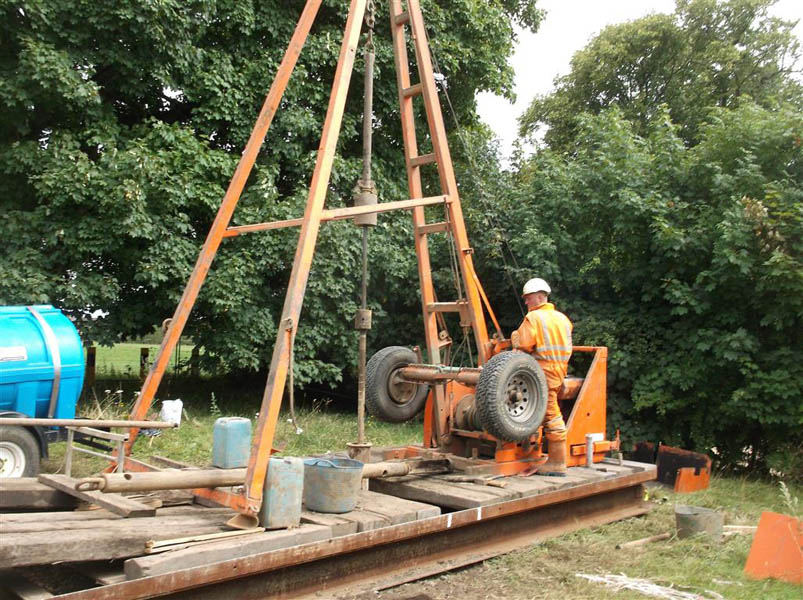
The procedure of the Standard Penetration Test begins with drilling a borehole to the desired depth using a rotary or auger drill. A standard split-barrel sampler is then lowered into the borehole and driven into the soil with a hammer weighing 63.5 kilograms dropped from a height of 760 millimeters. The number of blows required to drive the sampler 300 millimeters into the soil is recorded, while the first 150 millimeters are considered a seating drive. The sum of the remaining 150 millimeters of penetration provides the N-value, which indicates soil resistance.
This N-value is crucial for understanding soil characteristics. Low N-values generally indicate soft or loose soils, which may require soil improvement or deeper foundations, while higher N-values suggest dense or stiff soils that can support standard foundation designs. The Standard Penetration Test is often performed at multiple depths to create a soil profile, allowing engineers to assess variations in soil conditions and determine suitable foundation types.
Visual representation of the test can help clarify the process. Many laboratories, including Inch-On Materials Testing Laboratory, provide diagrams and detailed reports showing the N-values at various depths, along with soil classification, moisture content, and other relevant data.
Field Testing vs. Laboratory Testing
While the Standard Penetration Test is conducted on-site, laboratory testing complements field results by providing more detailed analysis of soil properties. Field testing delivers immediate insights into soil density and strength, while laboratory tests confirm soil classification, compaction, moisture content, and other parameters that affect foundation performance.
Laboratory procedures performed by accredited facilities, such as Inch-On Materials Testing Laboratory, follow ASTM and AASHTO standards. These tests include moisture content determination, Atterberg limits, soil classification, compaction tests, and analysis of aggregates. Combining field SPT data with laboratory results creates a comprehensive understanding of subsurface conditions, ensuring foundation design is both safe and efficient.
Using an independent, accredited laboratory ensures unbiased results. Clients can rely on the accuracy of SPT testing and supporting laboratory analysis to make informed decisions for structural design, material selection, and construction planning.
Applications of Standard Penetration Test Results
Results from the Standard Penetration Test influence several aspects of construction and foundation engineering. Engineers use N-values to determine soil bearing capacity, select appropriate foundation types, and identify potential need for soil stabilization. Applications include:
- Design of shallow foundations such as strip or pad footings
- Design of deep foundations such as piles and caissons
- Estimation of settlement and load distribution
- Assessment of liquefaction potential in earthquake-prone areas
- Planning for soil improvement measures, including compaction or reinforcement
Projects across residential, commercial, and industrial sectors benefit from SPT data, as the test provides reliable, measurable, and repeatable information about soil behavior under load. By integrating these results into project design, engineers minimize risks and enhance structural performance.
Why Choose Inch-On Materials Testing Laboratory
Established in 2018, Inch-On Materials Testing Laboratory provides expert Standard Penetration Test services across the Philippines. Accredited by DPWH-BRS, the laboratory follows strict ASTM and AASHTO standards to ensure accuracy, reliability, and compliance. Inch-On combines field evaluation with laboratory testing to provide a complete geotechnical solution for any construction project.
The laboratory employs experienced professionals and modern equipment to perform SPT, pile load tests, soil compaction analysis, concrete testing, and more. Clients benefit from detailed reports with clear explanations, soil profiles, and recommendations for foundation design. Choosing Inch-On ensures that projects are built on reliable data, reducing risk and enhancing safety for every structure.
Takeaway
The Standard Penetration Test remains an essential tool for construction professionals seeking to understand soil properties and design safe foundations. Accurate SPT results, combined with laboratory analysis, allow engineers to make informed decisions, avoid costly mistakes, and comply with regulatory standards. Contractors, developers, and architects in the Philippines rely on accredited laboratories such as Inch-On Materials Testing Laboratory for precise soil evaluation and geotechnical guidance.
Scheduling a Standard Penetration Test early in the planning phase of a project helps ensure structural integrity, long-term safety, and cost-efficient construction. Projects built on thoroughly tested soil are better prepared to withstand environmental challenges, deliver reliable performance, and meet the highest industry standards.
FAQ: Standard Penetration Test
What is the main purpose of the Standard Penetration Test?
The main purpose of the Standard Penetration Test is to evaluate the density, consistency, and load-bearing capacity of soil to guide foundation design.
How is the N-value determined in the Standard Penetration Test?
The N-value is determined by counting the number of hammer blows required to drive a standard sampler 150 millimeters into the soil after a seating drive. It represents soil resistance to penetration.
Why is the Standard Penetration Test important for construction in the Philippines?
The test provides accurate site-specific data for foundation design, helping ensure safety and compliance with DPWH-BRS standards, which is crucial in areas with varying soil conditions.
Can the Standard Penetration Test be combined with laboratory testing?
Yes. Field SPT results are often complemented by laboratory tests such as soil classification, moisture content, and compaction analysis to provide a complete understanding of soil conditions.
How deep can the Standard Penetration Test be performed?
The SPT can be performed at various depths depending on project requirements, typically until competent soil layers are reached to support structural loads.
Who should conduct the Standard Penetration Test?
Qualified and accredited laboratories like Inch-On Materials Testing Laboratory, which follow ASTM and AASHTO standards and are recognized by DPWH-BRS, should conduct SPT to ensure accurate results.
How soon are results available after the Standard Penetration Test?
Preliminary N-values are recorded immediately on-site, while detailed reports including laboratory analysis are usually available within a few days, depending on project scope.