Reinforced Steel Bar Testing plays a critical role within modern construction projects. Steel reinforcement bars serve as the internal support system of concrete structures, providing the tensile strength necessary to withstand heavy loads, environmental stress, and seismic activity. Without proper testing and verification, construction materials may fail to meet required standards, placing buildings, bridges, roads, and infrastructure projects at serious risk.
Construction professionals rely on Reinforced Steel Bar Testing to confirm that steel products satisfy mechanical and structural requirements before installation. Testing procedures help determine whether reinforcing steel bars possess the required strength, ductility, flexibility, and durability necessary for safe structural performance.
ASTM A370 remains one of the most recognized standards used for Reinforced Steel Bar Testing. This testing standard establishes procedures for evaluating the mechanical properties of steel products through tensile testing, elongation measurement, bend testing, and yield strength analysis.
Accurate testing supports quality assurance, regulatory compliance, and long-term structural reliability. Projects that invest proper attention toward Reinforced Steel Bar Testing reduce the possibility of premature material failure, costly repairs, project delays, and structural defects.
What Is Reinforced Steel Bar Testing?
Reinforced Steel Bar Testing refers to the mechanical evaluation of reinforcing steel bars used within concrete construction. The primary goal of Reinforced Steel Bar Testing is to verify whether steel products meet engineering specifications and national or international construction standards.
Concrete performs extremely well under compression but has limited resistance against tensile forces. Reinforcing steel bars compensate for this limitation by supplying additional tensile strength that helps structures resist cracking, bending, and collapse.
Several important mechanical properties are evaluated during Reinforced Steel Bar Testing, including:
- Tensile strength
- Yield strength
- Elongation
- Ductility
- Bend resistance
- Structural flexibility
Laboratory technicians conduct these tests using calibrated testing equipment designed to apply controlled force and measure steel behavior under stress conditions. Results obtained from Reinforced Steel Bar Testing help engineers determine whether materials are suitable for structural applications.
Construction projects involving residential buildings, commercial facilities, industrial plants, highways, bridges, and high-rise structures all depend on reliable Reinforced Steel Bar Testing to maintain structural safety and compliance.
Why Reinforced Steel Bar Testing Matters
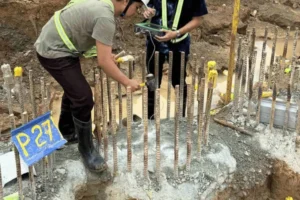
Reinforced Steel Bar Testing serves as a major quality control procedure within construction projects. Steel reinforcement bars experience tremendous stress during the lifespan of a structure. Weak or defective steel may lead to cracking, excessive deformation, or catastrophic structural failure.
Several important benefits result from proper Reinforced Steel Bar Testing.
Structural Safety
Structural safety remains the primary reason for performing Reinforced Steel Bar Testing. Reinforcing bars must possess sufficient strength to carry structural loads safely during normal operation and extreme conditions such as earthquakes or typhoons.
Testing verifies that steel bars can tolerate required stress levels without permanent failure or excessive deformation.
Verification of Material Quality
Steel delivered to construction sites may not always match the specifications listed within mill certificates. Reinforced Steel Bar Testing confirms whether supplied materials comply with project requirements and approved engineering standards.
Grade verification helps identify discrepancies before steel installation begins.
Regulatory Compliance
Government agencies and engineering authorities require construction materials to satisfy approved testing standards. Reinforced Steel Bar Testing helps contractors and developers comply with ASTM, AASHTO, and DPWH requirements.
Compliance documentation also supports project inspections and regulatory approvals.
Long-Term Durability
Structures depend on durable reinforcement materials for long service life. Reinforced Steel Bar Testing helps identify steel bars with insufficient ductility, brittleness, or poor manufacturing quality that could compromise long-term performance.
Seismic Performance
Earthquake-prone areas require steel reinforcement with excellent ductility and elongation characteristics. Reinforced Steel Bar Testing evaluates the ability of steel bars to absorb and dissipate energy during seismic movement.
Proper testing supports safer building performance during seismic events.
ASTM A370 Standard for Reinforced Steel Bar Testing
ASTM A370 establishes standardized procedures for the mechanical testing of steel products. Many accredited laboratories follow ASTM A370 during Reinforced Steel Bar Testing because the standard provides consistent and reliable testing methodologies.
ASTM A370 includes procedures for:
- Tensile testing
- Yield strength determination
- Elongation measurement
- Bend testing
- Mechanical property evaluation
Following ASTM A370 helps ensure that Reinforced Steel Bar Testing produces accurate and repeatable results suitable for engineering analysis and regulatory compliance.
Construction professionals rely on ASTM A370 because standardized procedures improve consistency between laboratories and testing facilities.
Types of Reinforced Steel Bar Testing
Several testing methods are commonly performed during Reinforced Steel Bar Testing procedures.
Tensile Strength Testing
Tensile strength testing measures the maximum pulling force a reinforcing steel bar can withstand before fracture occurs.
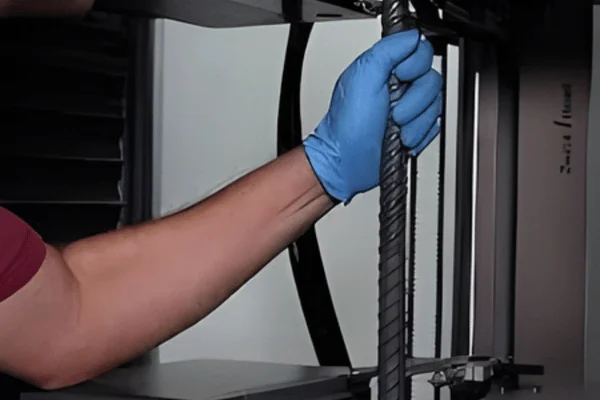
Laboratory technicians place steel specimens inside a Universal Testing Machine (UTM). The machine gradually applies tensile force until the specimen breaks. Test results reveal the ultimate tensile strength of the steel material.
Tensile strength remains one of the most important measurements within Reinforced Steel Bar Testing because reinforced concrete structures depend heavily on steel resistance against tensile stress.
Yield Strength Testing
Yield strength testing determines the stress level at which steel begins to deform permanently.
Before reaching yield strength, steel returns to its original shape after force removal. Beyond the yield point, permanent deformation occurs.
Reinforced Steel Bar Testing evaluates yield strength to ensure steel bars maintain structural integrity under service loads.
Elongation Testing
Elongation testing measures how much a steel bar stretches before fracture.
This procedure helps evaluate ductility and flexibility. Steel with poor elongation may fracture suddenly without warning, increasing structural risk.
Reinforced Steel Bar Testing uses elongation measurements to assess steel suitability for seismic and high-stress applications.
Bend Testing
Bend testing evaluates the ability of reinforcing bars to withstand bending without cracking or failure.
Construction activities frequently involve bending rebar during fabrication and installation. Reinforced Steel Bar Testing helps confirm whether steel bars can tolerate these conditions without material defects.
Rebend Testing
Rebend testing subjects steel specimens to repeated bending stress. This process evaluates fatigue resistance and long-term flexibility.
Reinforced Steel Bar Testing uses rebend procedures for projects requiring high durability and resistance against cyclic loading.
The Reinforced Steel Bar Testing Process
Reinforced Steel Bar Testing follows a systematic laboratory procedure designed to produce reliable and accurate results.
Sample Collection
Technicians collect representative steel bar samples from project deliveries or production batches. Proper sample identification ensures traceability throughout testing.
Specimen Preparation
Laboratory personnel prepare steel specimens according to ASTM A370 requirements. Proper specimen dimensions and preparation methods are essential for accurate Reinforced Steel Bar Testing results.
Mechanical Testing
Technicians place prepared specimens inside calibrated Universal Testing Machines. Controlled forces are applied while computerized systems record material behavior.
Mechanical testing may include tensile, yield, elongation, bend, and rebend procedures.
Data Analysis
Laboratory specialists analyze recorded measurements to determine whether steel bars satisfy specified standards and project requirements.
Reporting
Certified test reports summarize all Reinforced Steel Bar Testing results. Reports typically include:
- Yield strength values
- Tensile strength values
- Elongation percentages
- Pass or fail assessment
- Testing standards used
- Specimen identification details
Fast and accurate reporting helps construction teams avoid project delays.
Importance of Grade Verification During Reinforced Steel Bar Testing
Steel reinforcement bars are manufactured according to specific grade classifications. Common grades include Grade 40, Grade 60, and Grade 75 steel reinforcement.
Each grade possesses different mechanical properties and load capacities. Reinforced Steel Bar Testing confirms whether supplied materials match approved engineering specifications.
Using incorrect steel grades may create serious structural problems, including:
- Reduced load-bearing capacity
- Excessive cracking
- Premature structural failure
- Safety hazards
- Regulatory violations
Grade verification through Reinforced Steel Bar Testing protects contractors, developers, engineers, and project owners from material-related risks.
Reinforced Steel Bar Testing for Seismic Safety
Seismic regions require construction materials capable of withstanding repeated stress and movement during earthquakes.
Reinforced Steel Bar Testing helps determine whether steel reinforcement possesses sufficient ductility and flexibility for seismic applications.
Steel bars with high ductility can absorb and redistribute seismic energy more effectively than brittle materials. This property reduces the likelihood of sudden structural collapse during earthquakes.
Elongation testing and bend testing serve particularly important roles within seismic-focused Reinforced Steel Bar Testing procedures.
Projects located within earthquake-prone areas often require enhanced testing standards to satisfy engineering and government requirements.
Common Problems Identified Through Reinforced Steel Bar Testing
Reinforced Steel Bar Testing frequently identifies material issues that may otherwise remain undetected until structural problems occur.
Incorrect Steel Grades
Testing sometimes reveals steel bars that fail to meet specified grade requirements. Lower-grade materials may not provide sufficient structural capacity.
Poor Ductility
Some reinforcing bars exhibit low elongation and poor flexibility. Brittle steel increases the risk of sudden fracture during seismic activity or heavy loading.
Manufacturing Defects
Surface defects, internal inconsistencies, and improper manufacturing processes may weaken steel reinforcement.
Non-Compliance With Standards
Reinforced Steel Bar Testing may identify materials that fail ASTM or project-specific requirements.
Early detection prevents defective materials from entering active construction work.
Why Construction Projects Need Accredited Laboratories
Accredited laboratories play a vital role within Reinforced Steel Bar Testing. Reliable testing depends on calibrated equipment, qualified personnel, standardized procedures, and strict quality control systems.
Inch-On Materials Testing Laboratory provides Reinforced Steel Bar Testing services following ASTM and AASHTO standards.
As a DPWH-BRS accredited Engineering and Construction Laboratory established during 2018, Inch-On performs independent testing for soil, concrete, steel, and foundation systems.
The laboratory also conducts field testing and laboratory testing procedures designed to support construction quality assurance and structural safety.
Using calibrated Universal Testing Machines and certified testing procedures, Inch-On delivers accurate and dependable Reinforced Steel Bar Testing results that help contractors and engineers make informed decisions.
Fast digital reporting also supports project timelines by allowing quicker material approval and construction scheduling.
Benefits of Reinforced Steel Bar Testing for Construction Projects
Construction projects gain several important advantages through regular Reinforced Steel Bar Testing.
Better Quality Control
Testing confirms that reinforcement materials satisfy engineering and regulatory requirements before installation begins.
Reduced Structural Risk
Early identification of defective steel helps prevent structural problems and costly repairs.
Improved Construction Safety
Reliable reinforcement materials support safer buildings, bridges, and infrastructure systems.
Regulatory Compliance Support
Testing documentation helps projects satisfy government regulations and engineering inspection requirements.
Greater Long-Term Durability
Properly tested reinforcement materials contribute toward stronger and longer-lasting structures.
Project Cost Protection
Detecting defective materials early helps avoid demolition, reconstruction, delays, and legal liabilities.
Choosing the Right Reinforced Steel Bar Testing Laboratory
Selecting a qualified laboratory remains essential for accurate Reinforced Steel Bar Testing.
Construction professionals should evaluate several important factors before choosing a testing provider.
Accreditation
Laboratories should possess recognized accreditation from relevant engineering and regulatory agencies.
Testing Standards
Qualified laboratories follow internationally accepted procedures such as ASTM A370 and AASHTO standards.
Equipment Quality
Modern Universal Testing Machines and calibrated equipment improve testing accuracy and reliability.
Technical Expertise
Experienced laboratory personnel ensure proper specimen preparation, testing procedures, and data analysis.
Reporting Speed
Fast reporting helps maintain construction schedules and avoid unnecessary delays.
Takeaway
Reinforced Steel Bar Testing remains a critical component of modern construction quality assurance. Reinforcing steel bars provide the tensile support necessary for safe and durable concrete structures, making proper testing essential for structural reliability and public safety.
Mechanical evaluation procedures such as tensile testing, yield strength analysis, elongation measurement, and bend testing help verify whether reinforcement materials satisfy engineering specifications and construction standards.
ASTM A370 provides the foundation for accurate and standardized Reinforced Steel Bar Testing procedures used by accredited laboratories worldwide.
Construction professionals who prioritize Reinforced Steel Bar Testing benefit from improved safety, better quality control, stronger regulatory compliance, and greater long-term structural performance.
Reliable laboratories such as Inch-On Materials Testing Laboratory support construction projects through certified testing services designed to ensure dependable and compliant reinforcement materials.
Frequently Asked Questions About Reinforced Steel Bar Testing
What is Reinforced Steel Bar Testing?
Reinforced Steel Bar Testing refers to the mechanical evaluation of reinforcing steel bars used within concrete structures. Testing helps verify strength, ductility, elongation, and compliance with construction standards.
Why is Reinforced Steel Bar Testing important?
Reinforced Steel Bar Testing helps ensure structural safety, material quality, regulatory compliance, and long-term durability for construction projects.
Which standard is commonly used for Reinforced Steel Bar Testing?
ASTM A370 serves as one of the most widely used standards for mechanical testing of steel products.
What equipment is used during Reinforced Steel Bar Testing?
Laboratories commonly use calibrated Universal Testing Machines (UTM) to perform tensile, yield, and elongation testing procedures.
What properties are measured during Reinforced Steel Bar Testing?
Testing typically measures:
- Tensile strength
- Yield strength
- Elongation
- Ductility
- Bend resistance
Why does elongation matter during Reinforced Steel Bar Testing?
Elongation helps evaluate steel flexibility and ductility. Materials with higher elongation generally perform better during seismic events and heavy stress conditions.
How does Reinforced Steel Bar Testing support seismic safety?
Testing evaluates whether reinforcement materials possess sufficient ductility and flexibility to withstand earthquake-related movement and stress.
Who needs Reinforced Steel Bar Testing?
Contractors, engineers, developers, infrastructure companies, and government projects all require Reinforced Steel Bar Testing to support safe and compliant construction.